

Stickers vs Labels, What is the Difference?
Most people use the two words for the same thing, and most of the time nobody’s confused by it. The distinction only starts to matter when you’re about to order a few thousand of something. Order stickers when you needed labels and you’ll be hand-applying die-cut shapes to product jars all afternoon. Order labels when you wanted stickers and you’ll have something functional that nobody wants to keep.
The difference is the job, not the material
Both are printed adhesive. That’s where the similarity ends and the purpose splits.
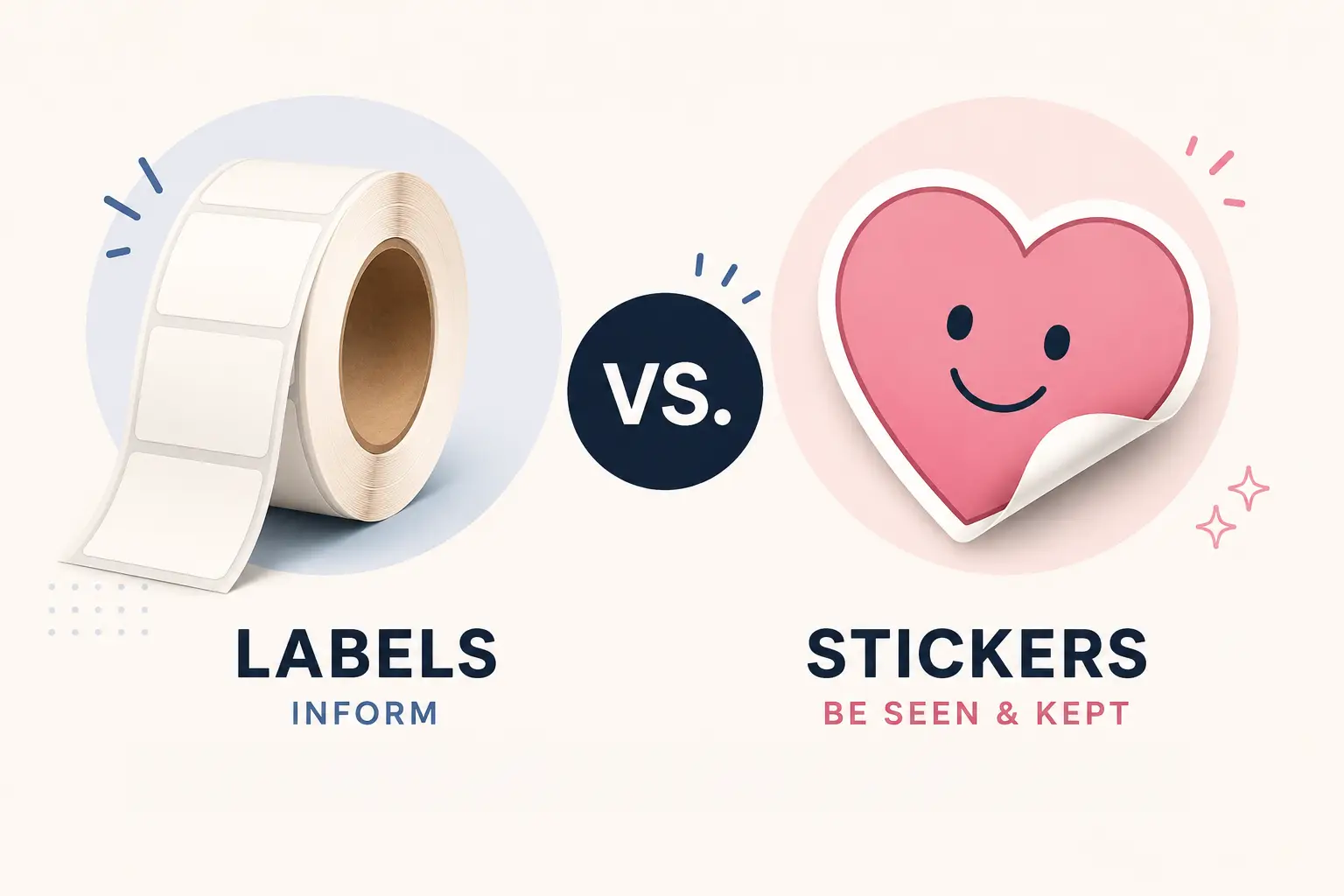
A label’s job is to inform. It carries what a product legally or practically needs: a barcode, ingredients, a batch number, a size, a price. It exists because the product can’t be sold or used properly without it. Nobody peels a label off a jar and puts it on their laptop.
A sticker’s job is to be seen and, ideally, kept. It carries a design, a logo, a joke, a piece of art. It exists because someone wanted it there. Its success is measured by whether people stick it somewhere.
Same technology, opposite intent. That’s the line worth holding onto when you’re deciding.
What that means in practice
The jobs pull the specs in different directions.
Format. Labels usually come on rolls or sheets, because they’re applied in volume, sometimes by machine. Stickers come as individual pieces or on kiss-cut sheets, because they’re applied one at a time by a person who chose to.
Material. Labels are often paper or a thin film, chosen for cost and print clarity at volume. Stickers lean toward vinyl, chosen for durability, because they need to survive being handled, carried, and stuck on things that move.
Shape. Labels are usually a simple rectangle, circle, or oval sized to fit a specific container. Stickers are often die-cut to the shape of the artwork, because the shape is part of the appeal.
Quantity. Labels are almost always ordered in bulk, since a product line needs one per unit. Stickers vary wildly, from one test print to a full merch run.
Lifespan. A label needs to last as long as the product does. A sticker often needs to last longer than whatever it’s stuck to.
Where they genuinely overlap
Plenty of things sit in the middle, and that’s not a problem to solve.
A packaging seal is a sticker doing a label’s job: it closes the box and carries your logo. A thank-you sticker in an order is pure sticker, no information required. A branded jar label with a beautiful design is a label that people sometimes do keep.
The overlap is where most small brands live, and the useful question isn’t which category it falls in. It’s whether the thing needs to carry required information (that’s a label constraint) or needs to be worth keeping (that’s a sticker constraint). Some things need both, and that’s fine, it just means neither cheap paper nor an impractical die-cut shape will work.
The mistake worth avoiding
Don’t use a sticker where the job needs a label’s function. Scannable barcodes, small legible required text, compliance information, anything applied to hundreds of units on a schedule, those are label problems, and solving them with die-cut vinyl stickers is expensive and slow.
Equally, don’t use a plain label where the point was to be memorable. A generic printed rectangle does the informational job and nothing else. If the goal was for someone to want it on their water bottle, that’s a sticker, and treating it as a labelling expense misses what it’s for.
What we recommend
Start from what the thing has to do. If it carries required information, has to scan, or gets applied in volume to a product line, you need labels, and the specs follow from the container and the compliance requirements. If it’s meant to be seen, chosen, kept, or handed out, that’s a sticker, and durability and shape matter more than cost per unit.
For the overlap cases, packaging seals, branded closures, thank-you inserts, stickers usually win, because they survive handling and people keep them. Order a small quantity first to see how it sits on your actual packaging before committing to a run.
When to contact support
Reach out if your project sits in the overlap and you’re unsure which specs matter, if you need something applied to a specific container size and want to confirm the fit, or if a design has to carry small legible text or a scannable code, since that affects both the size and material choice.
FAQ
Are stickers and labels the same thing?
Technically both are printed adhesive, but they do different jobs. Labels carry required product information and are applied in volume. Stickers carry design and are meant to be seen and kept.
Do I need labels or stickers for my product packaging?
If the packaging needs required information like ingredients, barcodes, or batch numbers, that’s a label. If you want branding, a seal, or something customers keep, a sticker does that better and survives handling.
Can I use stickers as product labels?
For small runs and simple needs, often yes. It gets impractical when you need hundreds applied on a schedule, or when small legible required text and scannable codes are involved.
What’s better for a packaging seal?
Usually a sticker. It closes the box, carries your logo, survives shipping, and customers frequently keep it, which a plain label doesn’t achieve.
Are labels cheaper than stickers?
Per unit at high volume, usually yes, because labels are built for exactly that. At low quantities the gap narrows and the durability difference often matters more than the cost difference.
Which lasts longer?
Stickers, generally. Vinyl with a laminate is built to survive handling, weather, and time. Labels are typically built to last as long as the product they’re on.

 Staff
Staff