

Are vinyl stickers waterproof?
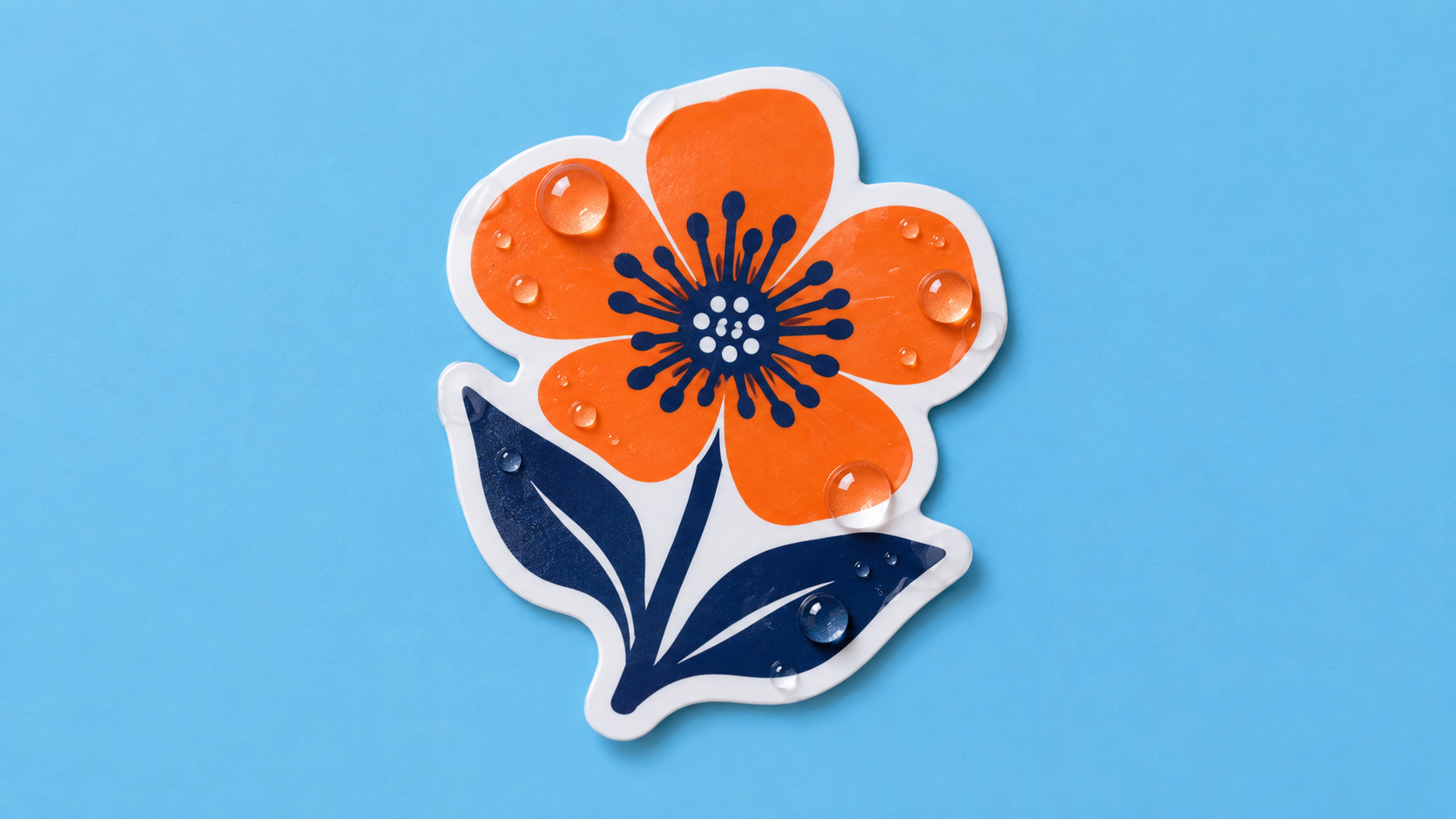
Yes, in the way most people mean it. A printed vinyl sticker copes with rain, spilled coffee and a bottle washed by hand, because vinyl doesn’t soak up water the way paper does. The accurate word for that is water-resistant. The dishwasher, mud and constant spray are a harder test, and whether a sticker passes depends on the laminate, the ink and the adhesive. “Vinyl” on a listing tells you what a sticker is made of, not what it has survived.
Every sticker we print is vinyl and water-resistant. Premium and Heavy Duty also handle the dishwasher, and Heavy Duty is used on motocross bikes and jet skis. If you’re not sure which one fits your job, ask us before you order.
Waterproof vs water-resistant
Waterproof means water can’t get through or do damage, however long it stays there. Water-resistant means a sticker copes with water in normal use: rain, splashes, a wipe with a damp cloth, a rinse under the tap.
On a sticker, water has three ways in. Vinyl itself doesn’t absorb it, but the ink on top can wash off if nothing protects it, and water that gets under a lifted edge works on the adhesive from behind. A sticker can be pure vinyl and still give up at the edge.
So when a product page says waterproof, read it as water-resistant until it tells you what was tested: how long, how hot and how often. A sticker made for your water bottle and one made for a bath toy are different products, and both get called waterproof.
What a vinyl sticker can take
Here’s how a laminated vinyl sticker handles the situations people actually ask about, and what decides the result in each:
| Situation | Result | What decides it |
|---|---|---|
| Rain and splashes | Fine | Edges that are stuck down properly |
| Wiping with a damp cloth | Fine | A soft cloth and ordinary washing-up liquid, nothing solvent-based |
| Hand washing a bottle or lunchbox | Fine | A sponge rather than a scourer, and not scrubbing at the edges |
| Condensation on a cold bottle | Fine once it has bonded | Putting it on dry and at room temperature |
| The dishwasher | Depends on the material | Premium and Heavy Duty handle it. Other stickers last longer washed by hand |
| Mud, spray and knocks | Depends on the material | Heavy Duty is built for it and is used on motocross bikes and jet skis |
| Outdoors through the seasons | Depends on the material | Sun is harder on a sticker than rain |
| Fully under water for long periods | Ask us first | The edges and the adhesive are where it gives way |
Water on its own is rarely the problem. Heat, friction and long soaks are what wear a sticker out, they start at the edges, and the material decides how much of that a sticker can take.
Why some vinyl stickers give up in water
When a sticker sold as vinyl fails the first time it gets wet, it’s usually one of four things:
- The print isn’t protected. Vinyl printed at home on an inkjet printer uses ink that can run when it gets wet, unless it’s laminated or sealed first. That’s why so many homemade “waterproof” stickers aren’t. If you print your own, here’s how to laminate stickers without a machine.
- It’s paper. A paper sticker with a glossy coating looks like vinyl right up until it meets a puddle. Then the edges go soft and the print blurs.
- The edge lifted. A sticker put on a dusty, curved or textured surface leaves a small gap at the edge, and water gets in behind it and works on the adhesive.
- It went on wet or cold. Adhesive needs a clean, dry surface at room temperature to grip properly, and a sticker that never gripped has nothing to hold on with when it gets wet.
The last two are about how the sticker was put on rather than what it’s made of, and why stickers peel and how to make yours hold goes through them in more detail.
How to tell if a sticker can take water
If you already have the sticker, test it before you trust a bottle to it. It takes a couple of minutes:
- Hold it under the tap for a minute, then rub the print with your thumb. If colour comes off on your thumb, the print isn’t protected.
- Look at the edge. If it has gone soft, fluffy or wavy, there’s paper in there somewhere.
- Stick one on a clean glass jar, leave the jar in the fridge overnight and wash it by hand the next day. It copies what a bottle goes through: cold, condensation and a sponge.
A sticker that comes through all three is ready for a bottle that gets washed by hand. Your thumb is a more reliable lab than a product description.
Water bottles, mugs and the dishwasher
Vinyl stickers work on water bottles, and that’s where a lot of them end up. Put the sticker on the smooth part of the bottle, away from the curve at the base and the thread for the lid, when the bottle is clean, dry and at room temperature.
The dishwasher is the hardest test in the kitchen. Every cycle aims hot water, detergent and spray straight at the edges, which is where stickers give up first. Our Premium and Heavy Duty stickers handle it. For anything else, including stickers you’ve printed at home, wash the bottle by hand.
Whatever the material, press the edges down firmly when you put the sticker on, because a lifted edge is where the water gets in.
Mugs work the same way. Ceramic is smooth and holds a sticker well, and if the mug goes in the dishwasher, choose Premium or Heavy Duty.
What we’d choose for wet places
For a water bottle, a laptop that travels or a bike frame, we’d choose Premium. It’s laminated, made for normal use indoors and outdoors, and it handles the dishwasher. Matte is just as good in the rain and at the sink, so choose it if you’d rather skip the shine, and wash the bottle by hand.
For anything that gets muddy, sprayed or knocked about, choose Heavy Duty. It has stronger adhesion and a tougher build, and it’s used on motocross bikes and jet skis, so a toolbox is an easy day for it.
Indoor stickers are unlaminated. That’s fine on a notebook, a box or packaging that stays dry, and the wrong pick for a bottle.
Make your own
Upload your design, choose the material and size, and the preview shows how the sticker will print before you order. A Canva export works as the file, and so does a phone photo, as long as it’s sharp. There’s no minimum, so you can order a single sticker and put it through the tap test before you order fifty for a market stall.
If the sticker is headed somewhere unusual, like a boat, a freezer or something that gets cleaned with strong chemicals, ask us first. We’ll tell you which material fits, or whether a sticker is the wrong tool for that job.
Waterproof stickers: common questions
Are vinyl stickers dishwasher safe?
It depends on the material. Our Premium and Heavy Duty stickers handle the dishwasher. Other vinyl stickers, including ones printed at home, last much longer on something washed by hand, because heat, detergent and spray work on the edges every cycle.
Are matte stickers waterproof?
Matte stickers are just as water-resistant as glossy ones. The finish changes how the surface looks and how much light it reflects, not how it handles water.
Can vinyl stickers go on water bottles?
Yes. Put them on the smooth part of a clean, dry bottle at room temperature, and choose Premium or Heavy Duty if the bottle goes in the dishwasher.
How do I know if a sticker is waterproof?
Hold it under the tap for a minute and rub the print with your thumb. If colour comes off or the edges go soft, it won’t cope with a wet life.
Are paper stickers waterproof?
No. Paper soaks up water, so the edges go soft and the print blurs. Choose vinyl for anything that gets wet.
Do vinyl stickers need to be laminated?
Not if they’re printed and laminated already. Vinyl printed at home on an inkjet printer does need a laminate or a sealant before it gets wet.
 Staff
Staff